Tuesday, 29 March 2022

JAL SE KAL, DIVYABHASKAR, KALASH – WEEKLY ARTICLE SERIES BY Dr.Yogesh Jadeja


Secure Groundwater Secure Life – Part I

JAL SE KAL, DIVYABHASKAR, KALASH – WEEKLY ARTICLE SERIES BY Dr.Yogesh Jadeja

કૉલમ: જલ સે કલ, યોગેશ જાડેજા, ACT સંસ્થા, ભુજ

“કુદરતે કચ્છને ઘણીવાર ‘બારે મેઘ વરસાવતા નહીં, બારે માહ તરસાવતા રાખ્યાં છે.”

 વર્તમાનપત્રો કચ્છના સારા વરસાદના સમાચારોથી ભરચક હોય. સુકાઈ ગયેલી નદીઓમાં બે કાંઠે પાણી વહેવા લાગે. તળાવ-તળાવડીઓ છલકી જાય. સિંચાઈના ડેમો ઓવરફ્લો થયાના સમાચારથી વહીવટી તંત્ર પણ રાજી થઈ જાય. માલધારી, ખેડૂતો, વેપારીઓના ચહેરા ઉપર રોનક આવી જાય. પરીની વાર્તા જેવું સમજવા કરતાં આ બધું આપણે શક્ય બનાવી શકીએ છીએ. છેલ્લા બે વર્ષની કોરોના મહામારીએ સમસ્યામાંથી ઉપાયો શોધતાં શીખવ્યું છે તેવી જ રીતે સ્થાનિક સ્ત્રોતોની જાળવણી અને તેના માટે વૈજ્ઞાનિક તેમજ સહભાગીદારીવાળો અભિગમ થકી પાણીની સમસ્યા પર ધાડ મારી શકાય.

 કચ્છમાં વરસાદ સૌરાષ્ટ્ર અને ગુજરાતના અન્ય વિસ્તારોના વરસાદ પછી આવતો. સામે અધકચરા ચોમાસાં અને ભયંકર દુષ્કાળ પણ નોંધાયેલા છે. એકસામટા ત્રણ કે ચાર ચોમાસાં સાવ કોરાં ગયાં હોય એવા બનાવો આ પ્રદેશે નિભવ્યા છે. પરંતુ આ સૃષ્ટિમાં કોઈ પણ વસ્તુ હમેંશ માટે નથી. બધેબધું અનિશ્ચિતતાથી ઉથલ્યા કરે છે. જે ક્ષણે જીવનો જન્મ થાય છે એ ક્ષણથી જ એનું મૃત્યુ નિશ્ચિત થઇ જાય છે. આ જીવન અને મૃત્યુ વચ્ચેના ગાળામાં ટકી રહેવા જરૂરી એવા પાણી વગર કલ્પના શક્ય જ નથી.

 માનવીય અભિગમની તરેહને ધ્યાને લીધા વિના સાવ સરળ રીતે કોઈને પણ સમજમાં આવે કે કુદરતે કચ્છ માટે ઘણીવાર ‘બારે મેઘ વરસાવતા નહીં પણ બારે માહ તરસાવતા રાખ્યાં છે.’ પાણીની સમસ્યાની ‘એક્સપાયરી ડેટ’ નક્કી કરવી જરૂરી છે. આમ, પાણીના બજેટ – વોટર બેલેન્સ જેવી પ્રક્રિયા દ્વારા કે તેના વપરાશને ડાહપણ ભરી રીતે ઉપયોગ પરીણામો મેળવવા એરિડ કોમ્યુનિટીસ એન્ડ ટેકનોલોજીસ સંસ્થાના વિવિધ મોડેલો અને સક્સેસ કેસ સ્ટડી સાથે લેખો પ્રસિદ્ધ કરવામાં આવશે. 

કચ્છના ભૂર્ગભજળને લોકભાગીદારીથી સાચવવા એજ પરમોધર્મ

કચ્છ હંમેશથી પાણી મુદ્દે કણસતો રહ્યો છે. આ માટે જમીનના તળમાંથી પાણી ઉલેચવાને બદલે જમીન પર પડતાં પાણીનું સંગ્રહ પાણીની સમસ્યા દૂર કરવાનો કચ્છ માટે શ્રેષ્ઠ ઉપાય છે. દુષ્કાળ અને ઓછા તેમજ અનિયમિત વરસાદ ધરાવતા કચ્છ જિલ્લા માટે ભૂગર્ભજળએ આજની તારીખે પણ પીવાના પાણી માટે, સ્થાનિક પરંપરાગત આજિવિકાઓ માટે કે પછી ઔધોગિક વિકાસની પ્રક્રિયાઓમાં કરોડરજજુ સમાન સ્ત્રોત રહ્યો છે. એ વાત અલગ છે કે આ સ્ત્રોતના બેફામ શોષણને કારણે તેના જથ્થા અને ગુણવતામાં ફેરફાર થયો છે.

સંસ્થા દ્વારા સહભાગી ભૂગર્ભજળ વ્યવસ્થાપન પ્રકલ્પો થકી કચ્છના ગ્રામીણ અને  શહેરી બન્ને વિસ્તારમાં સફળતાપૂર્વક અમલીકરણ કરવામાં આવ્યા છે. માંડવી તાલુકાના ૧૯ ગામો કે જ્યાં પાણીની જરૂરીયાતમાં ૩૨૦ લાખ ઘનમીટરની ખોટ હતી અને અમુક ગામોમાં ભૂગર્ભજળની ખારાશનું પ્રમાણ 3500 થી ૬૨00 ટી.ડી.એસ. જેટલું હતું. પરંતુ પાછળથી ભૂગર્ભજળમાં ૭૮ લાખ ઘનમીર જેટલો જથ્થો વધ્યો અને અતિખારાશવાળા વિસ્તારમાં ટી.ડી.એસ.નું પ્રમાણ ૩000 થી 4000 પી.પી.એમ. જેટલું ઘટયુ.

ટાટા સીજીપીએલ, સંસ્થા તથા લોકભાગીદારીથી કલસ્ટર એપ્રોચ અપનાવ્યું અને તમામ ગામોનું વિકેન્દ્રીત જળ સુરક્ષા આયોજન તૈયાર કરવામાં આવ્યું હતું. જેમાં ઉંડા થઇ ગયેલા ભૂતળને ફરી ઉપર લાવવા રીચાર્જ બોરવેલ, બંધ પડી ગયેલ કુવા- બોરને રીચાર્જ સ્ટ્રક્ટરમાં તબદીલ કરવું, પરંપરાગત સપાટીય સ્ત્રોતને આવ સુધારણા અને જળ ચક્રના સંતુલનમાં પાણી મળી રહે તેવી રીતે ખાણેત્રા વગેરે જેવા પુરવઠો વધારવાના કાર્યનું અમલીકરણ કરવામાં આવ્યું. આ કાર્યોને લોકો જવાબદારીપૂર્વક સમજે, સાચવે અને નિભાવે તે માટે તેઓનું ક્ષમતાવર્ધન અને કરવામાં આવ્યું. જેથી આવનારા સમયમાં પીવાના પાણી બાબતે સંપુર્ણ સ્વાયત બની જશે.

કચ્છની ભૂસ્તરીય લાક્ષણિકતાને સમજવી જરૂરી

આપણે માંડવી તાલુકાના ૧૯ ગામો કે જ્યાં પાણીની જરૂરીયાતમાં ૩૨૦ લાખ ઘનમીટરની ખોટ સામે ભૂગર્ભજળમાં વધારો અને અતિખારાશવાળા ગામોમાં ટી.ડી.એસ.નું પ્રમાણ ઘટાડી શક્યા તે ગામોમાં તો ઘટાડી શક્યાની વાત છેલ્લાં અંકમાં કરી હતી પરંતુ આવનારા સમયમાં પીવાના પાણી બાબતે સંપુર્ણ સ્વાયતતા મેળવવા માટેના વિધિગત તબક્કા શું છે એ સમજવું જરૂરી છે. જેનો પ્રાથમિક તબક્કો છે, કચ્છની ભૂસ્તરીય લાક્ષણિકતાને સમજવું.

કચ્છની ભુસ્તર બનવાની શરૂઆત આશરે ૧૮ કરોડ વર્ષ પહેલા થઈ હતી જે સમયે ઉપરની તરફ દરિયો અને તેની નીચે જમીન જેવી પરિસ્થિતિ હતી. કાળક્રમે જમીનની અંદર ભૌગોલીક ફેરફાર જેવા કે, જવાળામુખીની હલચલ, પૃથ્વીના જમીન ભાગોની પ્લેટોનું એકબીજા તરફ સરકવું વગેરે જેવા કારોણોને લીધે ધીરેધીરે જમીનનો ભાગ ઉપર આવવા લાગ્યો અને દરિયો જમીન પરથી સરકવા લાગ્યો.

૬.૫ કરોડ વર્ષ પહેલા કચ્છની જમીન પણ દરિયાની બહાર ઉપસી આવવાની શરૂઆત થઈ હતી. જે સમયને પૃથ્વીના ઉત્પતિ કાળનાં મેસોઝોઇક યુગ તરીકે ઓળખાવવામાં આવે છે. અને કચ્છમાં મળી આવતા અગત્યનાં દરિયાઈ જીવાવશેષો જેવા કે, એમોનોઈડ વગેરે તે બાબતની પુર્તતા કરે છે. કચ્છમાં મળી આવતા શેલ (મુલઈ), ઝીણાદાણાવાળો સાગ (ફાઈન ગ્રેઈન સેન્ડ સ્ટોન)ના એકાંતરીકરણ (ઈન્ટરકેલેશન) તથા ચિકણી માટીના ખડકો, ચુનાના પથ્થરનાં ખડકોના એકાંતરીકરણ એ દરિયાઈ બનાવટનાં ખડકો હોવા છતાં પણ કરછનાં મોટો ભાગનાં ડુંગરો પર મળી આવે છે જે સૂચવે છે કે કચ્છની ધરતીની ઉત્પતિ દરિયામાંથી થઈ છે. જેથી આજે પણ આ ખડકોમાં આવતું પાણી ઘણી જ વધારે માત્રામાં ખારાશ ધરાવે છે. આવી ખારાંશને Inherent Salinity કહેવાય છે.

આશરે ૧૦ કરોડ વર્ષથી કચ્છના સાગ પથ્થરમાં સંગ્રહિત છે પાલર પાણી

આ સમય બાદ જમીનનાં પેટાળમાં રહેલો લાવારસ, પ્લેટો સરકવાનાં કારણે ઉભા થયેલ તણાવ તથા દબાણ તેમજ વજનની અસમતુલાને પૃથ્વીના પોપડા પર નીચેથી દબાણ કરવા લાગ્યો જેને લીધે જમીનનો ભાગ દરિયાથી ઉપર આવવા લાગ્યો જેમ જેમ જમીન ઉપર આવવા લાગી તેમ તેમ તેના પર પર્યાવરણીય પરિબળોની અસરોને લીધે તથા વરસાદની અસરને લીધે નદીનાળાઓ વહેવા શરૂ થયા જે જુના ડુંગરોનું ધોવાણ થતાં અને જમીન પર પથરાતાં તે જુરાસિક કાળ બાદના ક્રિટેસીયા કાળનાં સાગ પથ્થર (સેન્ડસ્ટોન) રૂપે જમીન પર પથરાયો અને આ પ્રક્રિયા પુરી થાય તે પહેલા જમીન નીચેના જવાળામુખીનું દબાણ સહન ન થતાં મોટો પાયે જવાળામુખીની પ્રક્રિયા સમગ્ર પૃથ્વી પર થઈ જેથી જમીન પર કાળમીંઢ જેવા પથ્થરો બન્યા. આ પ્રક્રિયા લગભગ ૬.૫ થી ૮ કરોડ વર્ષ વચ્ચેની છે. કચ્છમાં મળી આવતાં ઘીણોધર, કાળો ડુંગર વગેરે આ પ્રકારની જવાળામુખીની પ્રક્રિયાના દૃષ્ટાંત છે. આ સમયકાળને પૃથ્વીની ઉત્પતિની ઈતિહાસના ડેક્કનટ્રેપ (કાળમીંઢ/બેસાલ્ટ) તરીકે ઓળખાય છે. આમ જુરાસીક કાળ પછીના ક્રિટેસીયસ તથા ડેકકનટ્રેપ સમયનાં ખડકો અનુક્રમે નદીના વહેતા પાણીથી તથા જવાળામુખીથી બન્યા હોઈ તેમાં ખારાશનું પ્રમાણ નહિવત્ત છે. આજે કચ્છમાં જે સાગ પથ્થર તરીકે ઓળખાય છે, તેમાં મળી આવતું ભુગર્ભજળ આશરે ૧૦ કરોડ વર્ષથી સંગ્રહિત વરસાદનું મીઠું પાણી છે.

જવાળામુખીથી બનેલ કાળમીંઢ પથ્થર જમીનથી બહાર આવ્યા બાદ પૃથ્વીનાં વાતાવરણની અસરમાં આવતા તેમાં રાસાયણીક ખવાણ થવાને લીધે લેટેરાઈટમાં પરિવર્તન થવાનું શરૂ થયું જે સમયને કચ્છમાં ટર્સરી યુગની શરૂઆત ગણવામાં આવે છે. અને આ યુગમાં કચ્છની જમીનનો પશ્ચિમ ભાગ હજી પણ દરિયામાં હતો જયાંથી કાળક્રમે દરિયો બહાર નિકળી જતાં પશ્ચિમ ભાગમાં ચુનાનાં પથ્થર, ચીકણી માટીનાં ખડકો વિપુલ પ્રમાણમાં મળી આવે છે.

ધરતીકંપને લીધે સિંધુ નદીના વહેણ કચ્છનાં રણમાંથી ફંટાઈ ગયાં.

ગત સપ્તાહે આપણે જે ટર્સરી યુગની શરૂઆતની વાત કરી તે જમીની ઊથલપાથલની પ્રક્રિયા આશરે એક લાખ વર્ષ પહેલા ચાલુ હતી એવું કહેવાયું છે.

૧૮ કરોડ વર્ષ પહેલા ગુજરાતની ઉત્તર-પુર્વનો થોડો ભાગ જ જમીન સ્વરૂપે હતો તેમાંથી ૨૦ લાખ વર્ષની આસપાસ સૌરાષ્ટ્ર તથા કચ્છનો મેઈનલેન્ડ પ્રદેશ દરિયાથી બહાર ઉપસી આવ્યો હતો ત્યાર બાદ છેલ્લા ૨૦૦૦૦ થી ૫૦૦૦ વર્ષ દર્મિયાન સમગ્ર ગુજરાત તથા સૌરાષ્ટ્રનો તમામ ભાગ મોટા ભાગનો કચ્છ મેઈનલેન્ડ તથા કેટલાક ટાપુઓ બહાર આવ્યા અને અંતે ૫૦૦૦ વર્ષ પહેલા લગભગ હાલમાં છે તે ગુજરાત, સૌરાષ્ટ્ર તથા કચ્છનું સ્વરૂપ અસ્તિત્ત્વમાં આવ્યું. દરિયાની આવનજાવન સાથે તથા જવાળામુખીની પ્રક્રિયા સાથે કચ્છની ધરતી પર ધરતીકંપ જેવી ટેકટોનિક પ્રક્રિયાનાં પણ ઉદારણ જોવા મળે છે જે બધી પ્રકિયાનાં ફળ સ્વરૂપે કચ્છની આજની જમીનનું સ્વરૂપ જોવા મળે છે. છેલ્લે ૧૮૧૯ માં થયેલ ધરતીકંપને લીધે કચ્છનાં રણમાં અલ્લાહબંધ બન્યો હતો જેને લીધે સિંધુ નદીના વહેણ જે પહેલા કચ્છનાં રણમાંથી વહેતાં હતાં ફંટાઈ ગયેલ.

પૃથ્વી પર જીવસૃષ્ટીની શરૂઆત આમ તો લગભગ ૩૫૦ કરોડ વર્ષ પહેલા થઈ હતી. સૌથી પહેલો દરિયાઈ જીવ અમીબા (એકકોષી) હતો ત્યાર બાદ તેમાંથી ધીરેધીરે બીજા સજીવો બનવાની શરૂઆત થઈ જેમાં અમીબા પછી માછલીઓ અસ્તિત્ત્વમાં આવી ત્યાર બાદ નાના જીવાણું અસ્તિત્ત્વમાં આવ્યા ત્યાર બાદ પ્રાણીઓ અસ્તિત્ત્વમાં આવ્યા અને પછી ડાયનોસોર અને સસ્તન પ્રણીઓ ઉત્પન થયા અને ત્યાર પછી પક્ષીઓ અસ્તિત્વમાં આવ્યા. આમ, ધીરેધીરે પૃથ્વી પર જીવ સૃષ્ટિની રચના થઈ હતી. કચ્છમાં વનસ્પતી ઉગવાની પ્રક્રિયા આશરે ૭ થી ૮ કરોડો વર્ષ પહેલા થઈ હતી. જેની નોંધ અને પુરાવા આજના સંશોધનમાં શક્ય બન્યા છે.

દરિયાઈ ગમન – આગમનના લીધે કચ્છનાં ભુસ્તરની રચના

કચ્છનાં ભુસ્તરની રચના મુખ્યત્વે દરિયાઈ ગમન – આગમન અને ટેકટોનિક પ્રક્રિયા જવાબદાર છે. આવી પ્રક્રિયાઓ જેવી કે, જવાળામુખી ફાટવાની લીધે કે ધરતીકંપ થવાની લીધે થઈ છે જેના લીધે જુદા જુદા ખડકો બન્યા છે. આ ખડકો પાણી સંગ્રહના સ્ત્રોત પણ છે. ક્યાંક જવાળામુખીનાં કારણે અગ્નિકૃત ખડકો બન્યા તો ક્યાંક દરિયાઈ અને વહેતા પાણી તેમજ હવાનાં લીધે જળકૃત ખડકો બન્યા છે અને ટેકટોનિક પ્રક્રિયાને કારણે કેટલાક વિકૃત ખડકો પણ બન્યા છે.

જેમાંથી કચ્છમાં નીચે પ્રમાણેના મુખ્ય જળકૃત અને અગ્નિકૃત ખડકો જોવા મળે છે.

પ્રકારનામબનવા માટે જવાબદાર પરિબળ
જળકૃતસેન્ડસ્ટોનદરિયાઇ પાણી, નદીના વહેતા પાણી, હવાથી ઉડીને આવેલ રેતી
શેલદરિયાઇ પાણી, નદીના વહેતા પાણી
ચીકણી માટીદરિયાઇ પાણી તથા નદીના પાણીનાં સમાગમના સ્થાને બન્નેની
ચુનાનો પત્થરદરિયાઇ પાણીમાં ચુનાનો નિતાર
અશ્મિયુક્ત ચુનાનો ખડકદરિયાઈ પાણી
માર્લદરિયાઇ પાણીમાં અતિ સુક્ષ્મ ચુનાનો પાવડરનો નિતાર
અગ્નિકૃતકાળમીંઢજવાળામુખી ફાટવાથી લાવારસનું જમીન પર આવીને તરતજ ઠંડા પડવું
વિકૃતક્રીસ્ટલાઇન લાઇમસ્ટોનજવાળામુખી જેવી પક્રિયાના કારણે ચુનાના પત્થરમાં ઘુસી ગયેલ લાવારસના કારણે પેદા થયેલ ગરમી તથા દબાણને કારણે આવેલ બદલાવ
ફોલ્ટ બ્રેસીયાસ્તરભંગના કારણે બનેલ ખડકોના ટુકડાઓનું પાછા નવા પ્રકારના ખડકમાં રૂપાંતરણ


જળસંગ્રહની વર્તણૂકના આધારે અલગ અલગ પ્રકારના ખડકોની ઓળખ

જમીનની સપાટીથી નીચે મળી આવતા પાણીને આપણે ભુગર્ભ જળ તરીકે ઓળખીએ છીએ. આવું પાણી કેટલી ઊંડાઇએ મળી આવે છે તથા તેનું ત્યાં મળી આવવા માટે કયા પરિબળો જવાબદાર છે તેના આધારે તેને વર્ગીકૃત કરવામાં આવે છે. ખડકોની પાણી સાથે અલગ અલગ પ્રકારની વર્તણુંકના આધારે એકવીફર, એકવીલુડ, એકવીફયુઝ અને એકવિતાર્ડ એમ ચાર પ્રકારે ઓળખ અપાઈ છે.

સેન્ડસ્ટોન, વેધર્ડ બેસાલ્ટ, કાંપ, રેતી વગેરે જેવા ખડકો કે જે પાણીનો સંગ્રહ કરે તથા મુકત પણ કરે છે તે કચ્છમાં મળી આવતા એકવીફરનાં ઉદાહરણ છે. કલે/ચીકણી માટી, લાઈમસ્ટોન જેવા મુખ્ય સ્ત્રોતો પાણી સંગ્રહ કરે પણ મુકત નથી કરતાં તેને એકવીલુડ કહે છે. એવા ખડકો કે જે પાણી સંગ્રહ પણ ના કરે અને મુકત પણ ના કરે તેને એકવીફયુઝ કહેવામા આવ્યા છે. જેના ઉદાહરણમાં આપણે કોમ્પેકટ બેસાલ્ટ (કઠણ કાળમીંઢ) કહી શકીએ. કાંકરા, રેતી, ચીકણી માટીના લૂસ પ્રકારના ખડકો એ ચોથા પ્રકાર એકવિતાર્ડમાં ગણાય છે.

કોઈ પણ ખડકની એકવીફર હોવા માટેની અગત્યની લાક્ષણિકતાઓ એ તેની છિદ્રતા તથા તેની પાણી વહન કરવાની ક્ષમતા પર આધાર રાખે છે. છિદ્રતા (પોરોસીટી) એ સંગ્રહ ક્ષમતા નકકી કરતું પરિબળ છે જેનો મુખ્ય આધાર તેમાં રહેલા કણોની (ગ્રેઈન) સાઇઝ, તેમની વચ્ચેની જગ્યા તથા કણોના આકાર પર રહેલો છે. બીજો આધાર વહનતા છે જેને આપણે પરમીયાબીલીટી પણ કહીએ છીએ, એ પાણી મુકત્ત કરવાની ક્ષમતા નકકી કરતું પરિબળ છે જે ખાસ કરીને એકવીફર ખડકનું નમન, રીચાર્જની દિશા, આસપાસની ટેકટોનિક વ્યવસ્થા તથા ભૌગોલીક વ્યવસ્થા પર આધારિત છે.

કચ્છનાં ભુગર્ભજળમાં ખારાશનાં મુખ્યત્વે ત્રણ સ્ત્રોતો છે.

જે એકવીફરની આપણે અગાઉ વાત કરી તેમાં ખારાશ એ મુખ્ય મુઝવતો પ્રશ્ન છે. તેથી ખારાશની પ્રક્રિયા સમજવી જરૂરી છે. તે માટે કચ્છની ભુસ્તરીય રચના તથા આબોહવાકીય પરીબળો જવાબદાર છે.

કચ્છનાં ભુગર્ભજળમાં ખારાશનાં મુખ્યત્વે ત્રણ સ્ત્રોતો છે. ડુંગરાળ વિસ્તારનાં ખડકોની ખારાશ કે જે મુખ્યત્વે દરિયાઈ પાણીની પ્રક્રિયાથી બનેલા હોવાનાં લીધે જન્મજાત સચવાયલી ખારાશ છે. જ્યારે રણ તથા બન્ની પ્રદેશમાં ઉચા બાષ્પીભવનાંકને લીધે દીન પ્રતિદીન વધતી જતી ખારાશ છે. જ્યારે ત્રીજું ખુબ જ અગત્યનું પરિબળ છે જે માનવીય વૃત્તિને લઇને છે જેમાં ભુગર્ભજળનું શોષણ મુખ્ય છે, જેનાં લીધે દરિયાઈ પાણી એ ભુગર્ભજળમાં ધસી આવીને તેને ખારું બનાવે છે.
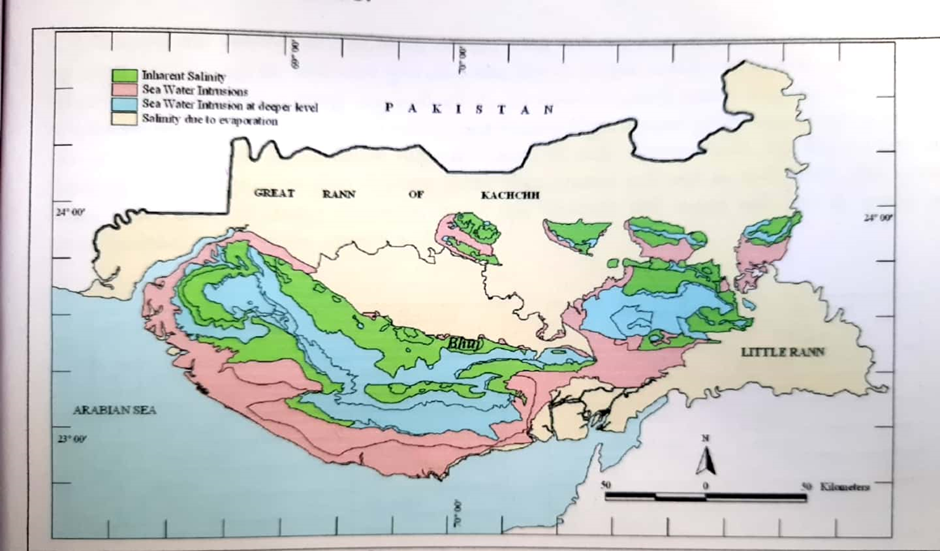
  •     કચ્છમાં ખારાશ વાળા વિસ્તારો

ખારાશની વાત વખતે બન્નીના ઘાસિયા મેદાનની વાત છે જરૂરી

બન્નીના ઘાસિયા મેદાનો સંપૂર્ણપણે દરિયાની ખારાશવાળા છે જે દક્ષિણમાં મેઇન લેંડ, લિનિયર ટ્રેન્ડસ અને ઉત્તરના ટાપુઓને આવરી લે છે. બન્નીનાં ઘાસિયાં મેદાનો એકદમ સપાટ કહી શકાય કે જે દરિયાની સપાટીએથી ૩ થી ૧૦ મીટરની ઊંચાઇએ આવેલાં છે (રોય, 1973૩). આ વિસ્તારની જમીન રેતાળથી ચીકણી માટીની બનેલી છે. જેથી તેની નિતારશકિત ઓછી હોવાથી વરસાદી પાણી આ સંપૂર્ણ વિસ્તારમાં ફરી વળે છે (જીઇસી ૧૯૯૫). દક્ષિણના મેઇન લેંડ અને ઉત્તરના ટાપુઓ આ વિસ્તારના આવક્ષેત્ર છે. સારો વરસાદ પડે ત્યારે અહીં ઘાસ અને ઓછી ઊંચાઇનાં વૃક્ષો ઊગી નીકળે છે. ફોટો દ્વારા વધુ સ્પષ્ટતા મળશે.
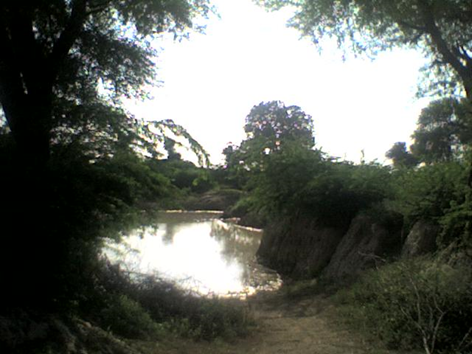
ઘાસિયાં મેદાનો વચ્ચે કુદરતી ખાડાવાળા વિસ્તારો પણ આવેલા છે.

બન્નીનાં ઘાસિયાં મેદાનો વચ્ચે કેટલાક કુદરતી ખાડાઓવાળા વિસ્તારો પણ આવેલા છે જેને સ્થાનિક ભાષામાં તેના ક્ષેત્રફળ આધારે ‘ઢંઢ’ અથવા ‘ઠઠ’ ના નામથી ઓળખવામાં આવે છે જે ભૂગર્ભના ભંગાણની પક્રિયાનો અણસાર આપતાં જમીનનાં સ્વરૂપો અને દરિયો બહાર નીકળી ગયા બાદ રહી ગયેલા ભૂમિ સ્વરૂપો છે. અહીં ચોમાસા બાદ પાણીથી ભરાઇ જતા હોય છે અને બારેમાસ પાણી ભરાઇ રહેતાં યાયાવર પક્ષીઓને આશ્રયસ્થાન પૂરું પાડે છે તેથી તે આકર્ષણનું મુખ્ય કેન્દ્ર છે. છારીઢંઢ એ અહીંનું ખૂબ જાણીતું ભૂમિ સ્વરૂપ છે. ઠઠ એ પ્રમાણમાં છીછરા ખાડાઓ છે, જેમાં ઉનાળે પાણી સુકાઇ જાય છે, જે આ વિસ્તારમાં પીવાના પાણી માટે સ્ત્રોત તરીકેની સવલત પૂરી પાડે છે.
Tuesday, 19 October 2021

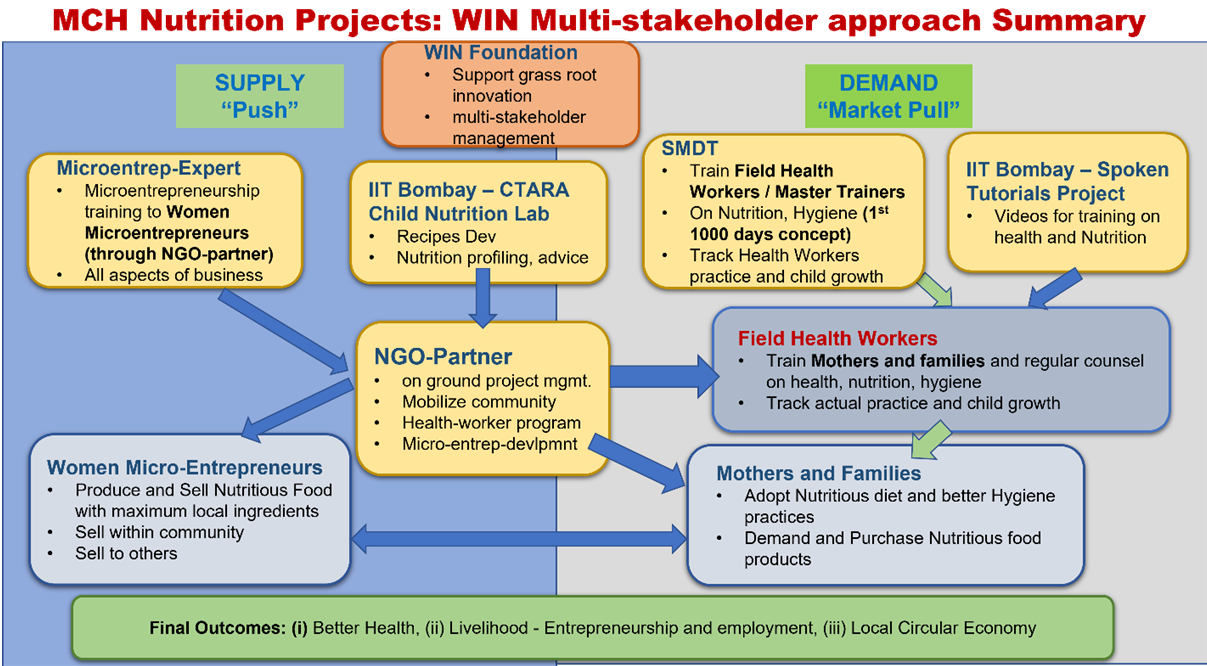
WIN Nutrition projects: Dual Push-Pull strategy


Malnutrition remains a serious problem affecting women and children in India, in spite of largescale programs by government and private charities. This has been further exacerbated due to Covid-19. A few important findings in the recently released NFHS 5 results illustrate this strongly:

  • Increased % Stunting among children, in 13 out of 22 states and UTs surveyed.
  • Increased % Wasting among children below 5, in 12 out of 22 states and UTs surveyed.

As traditional Supply based programs have shown slow results, WIN Foundation is trying to tackle this problem by addressing both Demand and Supply perspectives

1. Project overview


The project aims to reduce malnutrition among mothers, infant children and adolescent girls, among urban slums, rural or tribal areas, through the following dual approach:


  • Create Demand or Pull for nutritious food and hygiene among poor communities through awareness and habit formation programs, through women field health workers training and tracking and supporting their counselling activities among mothers and communities.
  • Address the Supply or Push factors by training and supporting women-led microenterprises for nutritious food production and sale to the community. This includes training and handholding them for all aspects of the business.Role of Various partners:
  1. WIN provides
    1. Project conceptualization, support, multi-stakeholder management
    2. initial seed funds for the women microentrepreneursCentral kitchen
    3. outcome monitoring for overall project
  2. Local NGOs provides support for
    1. all local activities, women mobilisations, activities for women in the community,
    2. on-ground coordination/follow-up with field health worker training, activities, impact
    3. Implement microentrepreneurship program with support from Microentreprenuership-expert, management of common resources like a central kitchen.
  • WIN selects local NGO partners based on the above. We have worked with MHT, Samerth, Saath in their respective geographical areas of work.
  1. Microentrepreneurship-expert partner
    1. Microentrepreneurship related training to NGO staff/managers
    2. Coaching sessions for Women micro entrepreneur teams
    3. Assessment of Staff/Managers and Women microentrepreneurs
  • WIN has worked with REAL and Mr Nikesh Ingle (professional microentrep-trainer)
  1. WIN’s partner for the training of Health Workers, (SMDT) provides:
    1. Training of Field Health Workers
    2. Follow up with health workers on their counselling and the status of children growth.
  2. IIT Bombay – Child Nutrition lab provides
    1. Support for recipe nutrition analysis, suggestions for enhancement
    2. Develop localised food-based recipes with enhanced nutrition.

2. Push (Supply) and Pull (Demand) processes

2.1 Microentrepreneurship development process:


  • Select potential microentrepreneurs and support them for all stages of business including market study, product development, supply chain, production, packaging, quality control, regulatory approvals, sales, marketing, branding, finance, HR etc., at regular intervals, over 18 months.
  • Provide them support for a seed fund, central kitchen etc.
  • In rural/tribal areas, kitchen-Nutri-garden to be promoted for healthy ingredients, apart from using them for home consumption, providing an opportunity for additional income.
    • A sample outline process is provided in Annexure A, which can be customised for each location.Overall Targets for each project area:
    1. About 25 women to form 5 microentrepreneurship teams after a mobilization and selection process
    2. At least 3 Women microentrepreneurship ventures to achieve stability with Rs. 60,000 to 75,000 Rssales per month at end of 18 months.
    3. Achieve business proficiency, build a cohesive team
    4. Achieve measured impact on nutrition among community
    5. At least 3 women from micro entrepreneur teams to become change agents in the community.

2.2 Build awareness and demand for Nutrition and hygiene


  1. Training of Trainers on Nutrition:
    a. A group of 25 to 30 field health workers, including Asha workers, Anganwadi workers and other community women and adolescent girls interested in becoming community health champions, are selected for training.
    b. Training is by SMDT, supported by a local NGO partner for ground-level coordination.
    c. Training on nutrition for 1st 1000 days starting from conception, including mother’s nutrition, newborn nutrition by mother’s feeding and subsequently additional food – up to approx. 2.5 years of age.
    d. Tracking of health parameters within the community by the field health workers, to track practices, mothers’ and child growth health and infant child growth.


  1. Mass awareness events and activities:
    These are community events, to engage the target group (adolescent girls, pregnant women, lactating mothers etc.) and disseminate relevant messages with the concept “Learn with fun”. They include a range of locally customised events and activities. A few examples of such events include:
    a. Food & Recipe Demonstration: Share recipes of simple nutritious food items with the target audience, homemade as well as those made by women microentrepreneurs to encourage healthy and nutritious food habits.
    b. Capacity-building of women groups: The women leaders from communities, adolescent girls, members of MahilaArogyaSamiti etc., are trained in Nutrition & Anaemia, Maternal Health, Sanitation & Hygiene, government schemes.
    c. Mamta Divas /Health check-ups: Educational and awareness campaigns to promote regular ante-natal check-ups, immediate breastfeeding, family planning, referral care, Haemoglobin check-up and safe deliveries in facilities of their choice.
    d. Water & Sanitation Governance: Training on hygiene, the importance of using the toilet, hand washing and other good hygiene practices, Water Quality Testing & Monitoring by Community Group, safe water storage and use.


Projects:

WIN Foundation has launched 3 projects so far – 2 in urban areas and 1 in rural areas, with 3 different on-ground NGOs. These cover a population base of approx. 40,000 and we are training over 10 women microentrepreneurship teams, and over 75 field health workers are being trained.

What people say  / Testimonials

Mr SirazHirani, Senior Program Management Specialist, Mahila Housing SEWA Trust

“Social issues are generally complex and require multi-sectoral interventions for a comprehensive solution that is sustainable. However, in the existing ecosystem, it is very challenging to plan such an intervention due to distinct mandates and funding sources of different stakeholders. WIN Foundation is very forthcoming in trying out new ideas that might seem challenging but promise lasting impact. The project titled “Women & Adolescent Girls Led Approach for Food & Nutrition Security in Urban Slums” is one such example wherein WIN Foundation facilitated multi-stakeholder consultation and designed a project involving 3 NGOs and 1 Social Enterprise bringing in distinct expertise of creating social capital, health, nutrition, WASH and entrepreneurship. This project addresses different interlinked issues of the poor urban community like malnutrition, health, livelihood, water & sanitation with a community-led approach. Such projects not only help to address complex social issues but also facilitate cross-learning between different partners.”

Dr Satish Agnihotri, Professor and Emeritus Fellow, Centre for Technology Alternatives for Rural Areas (CTARA) at IIT Bombay

WIN and ChiNu have similar thinking on the issue of food products. Both are looking at affordable, nutritious and convenient products. WIN is also supportive of decentralized production through SHGs and micro-entrepreneurs and promotes locally compatible foods. Of course many local foods e.g. Idli or Dhokla have now become national foods! We of course need to be careful about the quality control aspects and do local capacity building for this. I am sure the ChiNu – WIN partnership will be able to contribute to the important goal of tackling child malnutrition in the difficult times ahead in the post-pandemic era.
—————————————————————————————————————————————

If you are keen to introduce Mother and Infant Child Nutrition training in your area or village for field health workers, and thus contribute towards fighting malnutrition, and want to know more about the above training, feel free to reach out to us at info@winfoundations.org


Annexure A: Sample outline of Microentrepreneurship development process:

This may be modified to suit local conditions, to achieve the same or better objectives.


Sr. No.Broad Outline of Women Microentrepreneurship Development program (details may change – keeping objectives intact)
Total period: 18 months
1Mobilisation / Selection of Women for the Microentrepreneurship
1.1 Identification of potential micro-entrepreneurs from the community willing to undertake entrepreneurship ( the mobilisation  of women to be done by local NGO partner of WIN.)
1.2General session on the program for up to 40 women (approx), on introduction to the program for entrepreneurship, its emphasis on nutrition, discussion with participants in small groups.
1.3Selection of 25 women from above for full program – based on aptitude, interest, time, etc. (Criteria devised by WIN/NGO/Micro-entrep expert)
2Entrepreneurship journey – Basic Aspects Introduction and Team Formation
2.1What is business? What is entrepreneurship? Why do I want to do it?
2.2What are some elements of the business ( at the introductory level): markets, customers, goods/services, expenses – fixed, variable, CAPEX, price, profit, cash flow, team, brand names, etc. Emphasis on the need for nutrition for the community, market within and outside community
2.3Formation of teams – preferably with complementary skills
3Entrepreneurship – begin the journey
3.1How do you look at customers? What does the customer need? What does the customer like? (to sell nutrition products within the  community)
3.2A food product as a business: various food items – home-cooked, bought from outside, packed, unpacked, freshly cooked, or snacks and so on. Examples of each type of product and if they remember who makes or sells them?
3.3What is nutrition? Why do we need it? What are examples of nutritious food at home and from outside? Why do people need to buy food from outside (why can’t they make everything at home)? What are the motivating factors for going for nutritious food products?
3.4How would you select nutritious food to make and sell: ready to eat-packed, or freshly cooked and served, or supplements to be added to other food and so on? What is nutritious food for women and children? Why is this important for the community? What are food habits in the community? What are opportunities to sell food products in the community?
*** Market scanning/survey (of shops, products, customers etc) at each stage by women to help their self-discovery process.
3.5Consider Product options: Ingredients list, cooking process, packing and labelling process. Decide price etc. What nutrition needs do these products meet for the community and outside?
3.6.Select initial 1 or 2 products to make. Determine product recipe, ingredients, where to purchase from, initial price etc., initial packaging, initial marketing required. Etc.
*** In above steps 6 and 7, women may also need to be shown organized kitchens (which make snacks or restaurant kitchens which make and serve hot fresh food).
4Entrepreneurship journey – Get into action 1
4.1Make samples in small quantities of such products and do test marketing in the community – get customer feedback.  finance through this
4.2Based on feedback, Finalise initial products, production volume, purchase plan, price, marketing (marketing within community and outside community). Calculate the money required for this.
4.3Start production, packing and sale.
4.4Test market to external customers
4.5Keep track of money spent. Money earned etc. Start learning about practical
4.6Analyse results – sales, profits, contribution to community nutrition, learnings of the group, challenges, risks, group motivation and aspiration level.
4.7Awareness Session and to facilitate for – business entity formation, Pan Card, Bank account and other legal formalities
5Entrepreneurship journey – expand action
5.1Business planning for larger sales and more products (e,g. for a target of sales – 75,000 per month) – for next 1 year: What is a business plan? How do you make it?
5.2Marketing: what are they learning from low volume sales? Introduce all marketing aspects: product/price/promotion/place(distribution) and associated aspects: logistics, storage etc.
5.3Production: Production process for quality and consistency, packaging – for food safety, life and marketing/branding, finished goods storage. Inventory control. – experiential learning spread over this phase – but should meet the needs of product quality from an early stage.
5.4Understanding of finance, team (hr),
5.5Organise and execute production, marketing, sales, distribution for the planned volume – through an ongoing learning process, over about 6 -9 months. Achieve monthly sales target rate.
5.6Analyse results – sales, profits, contribution to community nutrition, learnings of the group on multiple dimensions, challenges, risks, group motivation and aspiration level, evaluation of each team member and their individual growth over this journey.
6Entrepreneurship journey – scale up stage
6.1At about 15 months stage, review business, nutrition outcomes among the community (build affinity/commitment with the community using this).
6.3Future plans: the need for more investment, source of funds like a bank, credit societies etc (which are actually available there), government schemes for women entrepreneurs.
6.4Make plans and tie up support for scaling up.
The above is given as a sample flow, and it can be changed, to achieve the same objectives in a better manner.


Tuesday, 13 July 2021

Bhujal Jankar: Learning experiences as para-hydrogeologists


Bhujal Jankar: Learning experiences as para-hydrogeologists

Introduction

Water shortages and its poor quality affect hundreds of districts in India. Our agriculture suffers from vagaries of water supply, seriously affecting the food and nutrition security of the country as well as livelihoods of millions of small farmers. The annual natural water cycle provides us with limited fresh water. On the other hand, the increased demand for water due to modern lifestyle and industry have led us to over-use surface water and over-extract groundwater. This has lowered water levels and increased salinity in groundwater. Pollution, both human and industrial, add to the water problems. The living ecosystem around us also requires water and seriously affected by water problems.

Hence, the governance and practices for water at various levels should ensure: (i) water conservation, (ii) optimized usage, (iii) recycling and reuse of water.

The above requires competencies and skills to be created at multiple levels, with particularly strong capacity at grass root levels.

Trainers’ perspective

For effective groundwater conservation and management, the beneficiary community’s involvement and participation plays a key role in the project. Our project partner, ACT’s experience of more than 15 years in Kachchh district has provided evidence that an intensive training of community members as para-geohydrologists, also known as ‘bhujal jankar’ benefits the project as well as the lives of the trainees. They acquire skills of data monitoring, data analysis, resource mapping, community mobilisation and preparing and implementing their village’s water security plans. They earn respect and credibility within their village community through the knowledge and skills acquired; and several livelihood opportunities open up for them. ‘Parab’ which is a private enterprise set up by trained bhujal jankars is a product of skill and capacity building programs. Through this, bhujal jankars now independently collect data, create water security plans and solve water issues.

Role of Online Courses / Programs in blended mode

To scale up above success, across hundreds of districts of India, a blended online / face-to-face model of training is being designed. This will enable sharing of expertise, learning resources, together with local learning support, to thousands of learners. The learners will be further able to use the online learning resources to familiarize other citizens, farmers, women etc., to make them adopt suitable practices. The learners will also be able to continue their learning continuously.

Trainees’ perspective

Rajadev Gadhavi – “Being a Krushak Mitra, I was working on agriculture related activities only, now having knowledge of Groundwater, will help not only in Moti Khakhar but also serve other villages to manage their groundwater”.
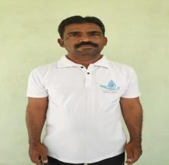
 

Ramesh Gor – “I will help village panchayat to form a water committee and shall promote water conservation and groundwater recharge activities as well as water efficient crops in farming”.
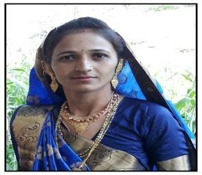



Hirbai Gadhavi
 – “will continue to promote Kitchen Garden and Vermicompost activities and will help women’s groups to set up economic activities to earn for their family”.


Sarad Nakar – “My dream is to provide GW service through Water resource Mapping to farmers of K-MARC Cluster Villages.  It’s a proud moment for me to be known as Bhujal Jankar as this terms gave me respect and recognition from village people that we are Pani testing vala! (people conducting water quality Analysis)

Riyaz Sumara – “I shall help village panchayat to form a Water Committee to manage and regulate use of groundwater


Shravan Bhati – “I would like to support farmers and village panchayats/ water committee to work on water budgeting and to adopt water efficient farming practice’’
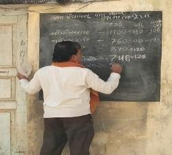


Devaraj Gadhavi – “I will continue to promote Crop water Budgeting Activity through Water meter and Also Promote Water Saving Crop Practices
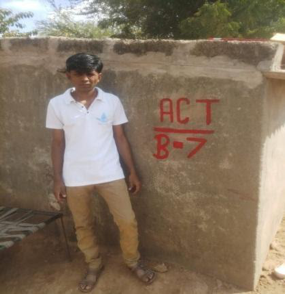
 

Haresh Kerai – “I will help farmers to understand availability of groundwater and adopt water saving techniques in farming”.


Monday, 21 June 2021

Multi-stakeholder Approach for Participatory Water Management in Rural and tribal Areas

  Jun 21, 2021  0 Comment  Water and Sanitation

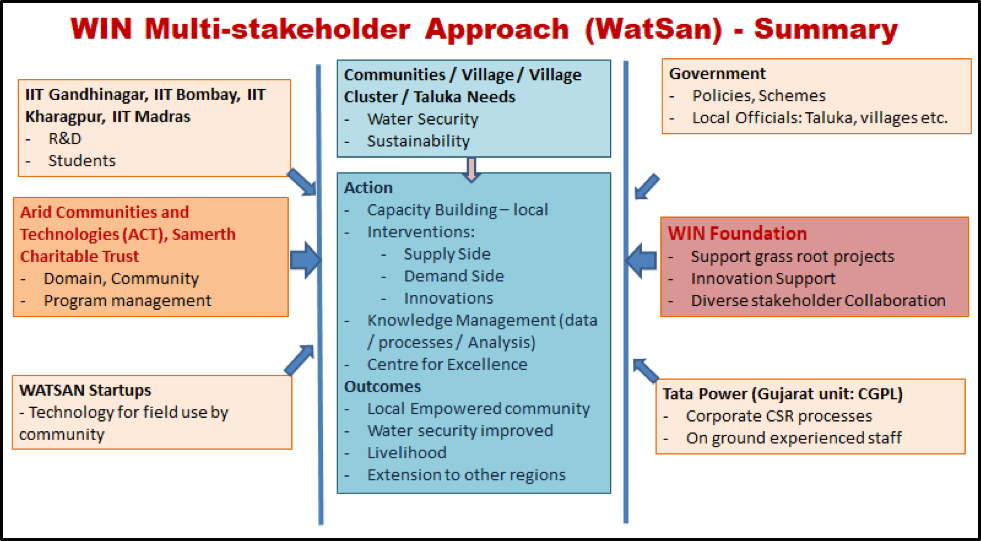
Robust participatory approach for Water Security and Conservation can overcome the water challenge facing our rural and tribal areas. This encompasses: 

  • capacity building of local communities through training of (i) village level hydrogeologists and water experts, and (ii) farmer and women groups for cooperative action
  • Water security master plan through local participation
  • Supply Side and Demand side interventions
  • Cost effective Technologies to bring better practices and knowledge
  • Knowledge management – development of processes and protocols for adaptation / adoption in other locations.

The Water Challenge

 “Water touches every aspect of development and it links with nearly every Sustainable Development Goal (SDG). It drives economic growth, supports healthy ecosystems, and is essential and fundamental for life itself. Some 2.2 billion people around the world do not have safely managed drinking water services, 4.2 billion people do not have safely managed sanitation services, and 3 billion lack basic handwashing facilities.”    – World Bank 

  • Water shortages and its poor quality affect hundreds of districts. Our agriculture suffers from vagaries of water supply, seriously affecting the food and nutrition security of the country as well as livelihood of small farmers.
  • The annual natural water cycle provides us limited fresh water. On the other hand, the increased demand for water due to modern lifestyle and industry have led us to over-use surface water and over-extract ground water. This has lowered water levels and increased salinity in ground water. Pollution due to human and industrial contaminants, has added to the water problems.
  • As Water is basic to all life on earth, it is also important to use water in a manner which protects the living ecosystems around us. This is particularly critical for living beings which reside in water.
  • Hence, the main objectives of governance model for water at various levels of government should be: (i) support conservation, (ii) optimized usage, (iii) recycling and reuse of water. 
  • The Government of India has recognised the massive challenges in Water and Sanitation domain and launched the Swachha Bharat Abhiyan, Atal Bhujal Yojana and Jal Jeevan Mission.

It is necessary to adopt multi-stakeholder approach to bring value to grass root interventions with multiple innovations in technology and processes, community empowerment and knowledge management

To introduce innovations for social impact in a sustainable manner, requires multiple partners in the ecosystem to collaborate.

Institution and Capacity Building

  • Local village level experts team – trained on geo-hydrology, Water Security planning,(may be called as Bhujal Jankar, Jaldoot, etc)
  • Farmers and Women Groups in villages for institution building, farming practices through collective decision making
  • Water Security Plan (WSP): Water supply and demand planning for all needs of village
  • Supply Side:
    • Ground water recharge: in village water bodies, river-bed, abandoned well
    • Desilting, embankment repair for village water bodies
    • River / canal water planning and storage of excess water
  • Demand Side:
    • Farming intervention support like drip irrigation, fodder crops, silt application, and so on
  • Technology introduction at grass root (affordable and usable by communities)
    • field level soil quality and moisture measurement
    • field Water quality and availability measurements
    • village level Weather forecast station
    • Modular cold chain for storage and transport of perishables
    • Smart agriculture and water conservation data system
  • Knowledge Management
    • Protocol, process development with community expertise built into the systems
    • guidance and support for Adoption of above in same hydrogeological region 
    • guidance and support for Adaptation of above in different hydrogeological regions

To Summarize, Multistakeholder collaborative approach brings synergistic benefits to community. Each stakeholder brings unique competencies, and enables accomplishing complete solutions significantly better than that achievable individually by each.

WIN Foundation has supported;

(i) Participatory Ground Water Management Project pioneered by Arid Communities and Technologies (ACT), Kutch, for water conservation. This project is also guided and supported by Coastal Gujarat Power Ltd (a Unit of Tata Power Limited in Kutch). CGPL provides on-ground support with its own team, logistics support and project monitoring and review support. 

(ii) Technology, products and process development projects with 4 IITs, covering water treatment, water distribution and waste-water processing, with further aim to translate the technology developed and apply in the field. 

(iii) It has supported several innovative startups in this domain, bringing their products through ACT and other NGOs to community, for the critical prototype -> test -> refine stage of product market validation.

If interested: 

Whether you are an NGO or Foundation working in water, or Gram Panchayat or a Government official working to improve water conservation practices, WIN Foundation and its partners are happy to share its knowledge. If interested in above, feel free to contact us at info@winfoundations.org

Friday, 11 June 2021

Training of Trainers – MATERNAL, INFANT AND YOUNG CHILD NUTRITION

 India is home to the largest number of hungry people in the world. The Global Hunger Index (GHI) 2018 ranks India at 103 out of 119 countries. Under recently released NHFS 5, 

A few important findings in the recently released NFHS 5 results illustrate this strongly:

  1. Increased % Stunting among children, in 13 out of 22 states and UTs surveyed.
  2. Increased % Wasting among children below 5, in 12 out of 22 states and UTs surveyed.
  3. Over 50% of women are anaemic.

As traditional Supply based programs have shown inadequate results, we need to look at it from Demand perspective – to create strong awareness and demand or Pull for nutritious food from mothers and communities.

Opportunity:

The 1,000 days between a woman’s pregnancy and her child’s 2nd birthday offer a unique window of opportunity to shape healthier and more prosperous futures. The right nutrition during this 1000-day window can have a profound impact on a child’s ability to grow, learn, and rise out of poverty. It can also shape a society’s long-term health, stability, and prosperity. 

  • During pregnancy, under-nutrition can have a devastating impact on the health if the mother and healthy growth and development of a child. 
  • Babies who are malnourished in the womb or in first two years of life have a higher risk of dying in infancy and are more likely to face lifelong cognitive and physical deficits and chronic health problems. 
  • Giving mother focused and continuous counselling during both pre and post child birth, through well trained and motivated field health workers:
    • Prebirth period: counselling for nutrition, prenatal vitamins,  appropriate intake of calories during pregnancy can halt the onset of malnutrition right from the womb. 
    • Post childbirth: counseling on breast feeding skills and nutrients-dense complementary feeding post 6 months, educating her on importance of vaccination, hygiene and sanitation.

By focusing on above, mothers and family members are empowered to seek healthy food and hygiene practices for themselves and the young babies. This will also create a strong pull or demand for healthy food items or ingredients as well as better hygiene practices.

Thus investing in better nutrition in the 1000-day window will help families, communities, and countries break the cycle of poverty. 

Long Term Goal of Training

To work towards the WHO Sustainable Development Goals targets 2025, and to improve

maternal, infant and young child nutrition by capacitating healthcare workers at the grassroots to

achieve:

  • 40% reduction in the number of children under 5 who are stunted
  • 50% reduction in anemia in women of reproductive age
  • 30% reduction in low birth weight
  • No increase in childhood obesity
  • Increase the rate of exclusive breast feeding in the first 6 months to at least 50%
  • Reduce and maintain childhood wasting to less than 5%

Overall Training Objective

The programme aims to:

  • To empower Filed Health workers as master trainers with the technical knowledge of Infant & Young Child Nutrition & counselling techniques, including mother’s nutrition, breast feeding, and supplementary feeding after 6 months of birth.
  •  To make them confident to impart the same training to their colleagues and to caregivers of young infant and children.
  • To help caregivers to help their children to survive and thrive, so that they reach their

physical and intellectual potential, by improving their knowledge of health, hygiene and nutrition and child development.

  • To reduce the incidence of malnutrition through regular data collection on child growth, prevention, raise alters for early detection and treatment; thereby reducing the incidence of stunting, wasting and associated ill health.

Training Methodology and Content:

SMDT has developed  “First 1000 Days” Training of the Trainers (‘TOT”) module tailored to the Health Care workers. The training approach is based on the principles of Skill development in breast feeding and complementary feeding counselling as well as nutrition Counselling in pregnant and lactating mothers. In-depth learning of the critical window period, pregnancy and nutrition and its role in the growth and Prevention of disease in a child is included. This comprehensive knowledge of the science of breast-feeding and complementary foods empowers the participants to deliver evidence-based dietary guidelines to tackle malnutrition at every stage of the first 1000 days of a child and beyond, and subsequently track growth of children at regular intervals. An interactive Training approach involves hands-on practicals to prepare them to impart high quality training to their co-workers as well as their beneficiaries. The module employs a variety of training methods, including demonstrations, discussions, case studies, critical thinking, team building, drama, role-play and problem solving. Participants are encouraged towards inquiry-based learning and sharing of experiences. The focus is on behavior change communication training, so that they feel empowered to convince caretakers to adopt the latest evidence-based advice. 

Learning Materials

Extensive pictorial and easy to use learning materials includes printed large format guides, charts and easy to use videos. These materials are useful for: .

  1. Learning by Health workers / Master Trainers during the training, and to revise learning
  2. Use same materials to counsel mothers on regular basis.
  3. Videos are available to view or download which mothers can view by themselves later.

Topics covered during trainings are:

  1. Science of nutrition
  2. Importance of the first 1000 days 
  3. Essential nutrition action (ENA)
  4. Counselling techniques for behavior change
  5. Pregnancy support counselling on health and nutrition
  6. Breast crawl
  7. Breast feeding technique 
  8. Breast feeding difficulties
  9. Breast conditions
  10. Breast feeding counselling techniques
  11. Not enough milk: usual scenario
  12. New-born care
  13. Minor illness of new-born/young child
  14. Guideline of complementary feedings
  15. Foods rich in minerals and vitamins, and their recipes
  16. Nutrition guidelines in pregnancy and for lactating mothers
  17. Behaviour issues of children during meals
  18. Safe preparation of meals and importance of good sanitation
  19. Myths busting
  20. Growth charts
  21. Growth monitoring and how to pick up if growth falters

Benefits/Anticipated Outcomes

  • Empowerment of the whole community to promote and maintain health, through understanding the importance of early nutrition and hygiene practices  for infant and young child nutrition.
  • Evidence-based skill building of breast feeding and appropriate complementary feeding, thereby preventing devastating acute as well chronic malnutrition in children.
  • Understanding the techniques of breast feeding positioning and latching, thereby improving the weight and length gain in the baby.
  • Understanding the technicalities of beast crawl and importance of colostrums, hence initiating breast-feeding within half hour of birth.
  • Increased demand for nutritious food and food ingredient, reduced consumption of junk food and empty calories, thereby improving both short and long-term health outcomes.
  • With better nutrition, children will be more likely to reach their physical and intellectual potential.
  • Understanding the importance of eating traditional foods and recipes not only for pregnant and lactating mothers, but also for children starting from 6 months of age.
  • Knowledge of cooking techniques, which increases nutrient content as well as digestibility of food preparations.
  •  Understanding the behaviour issues of children in relation to food and managing them effectively and confidently.
  •  Understanding science- and evidence-based feeding practices to reduce myths and doubts.
  • Make this knowledge and practices owned by community, to improve health and nutrition of the children and others, and pass on this knowledge for future generations.

If you are keen to introduce Mother and Infant Child Nutrition training in your area or village for field health workers, and thus contribute towards fighting malnutrition, and want to know more about the above training, feel free to reach out to us at info@winfoundations.org

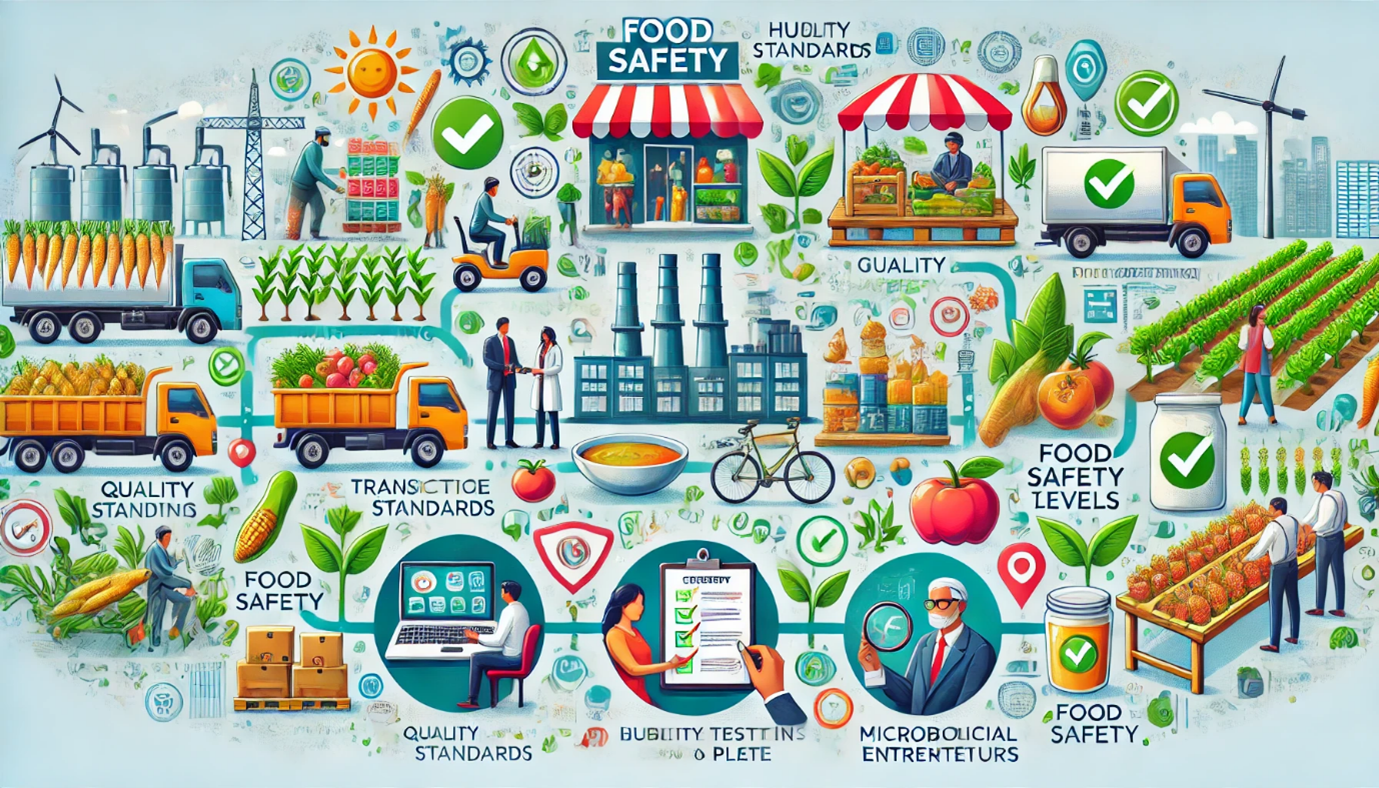
Food Safety for Nutrition Entrepreneurs

  Food Safety for Nutrition Entrepreneurs   Dr. Bhaskar Datta,Associate Professor, Chemistry  (Jointly with Biological Sciences and Engineer...